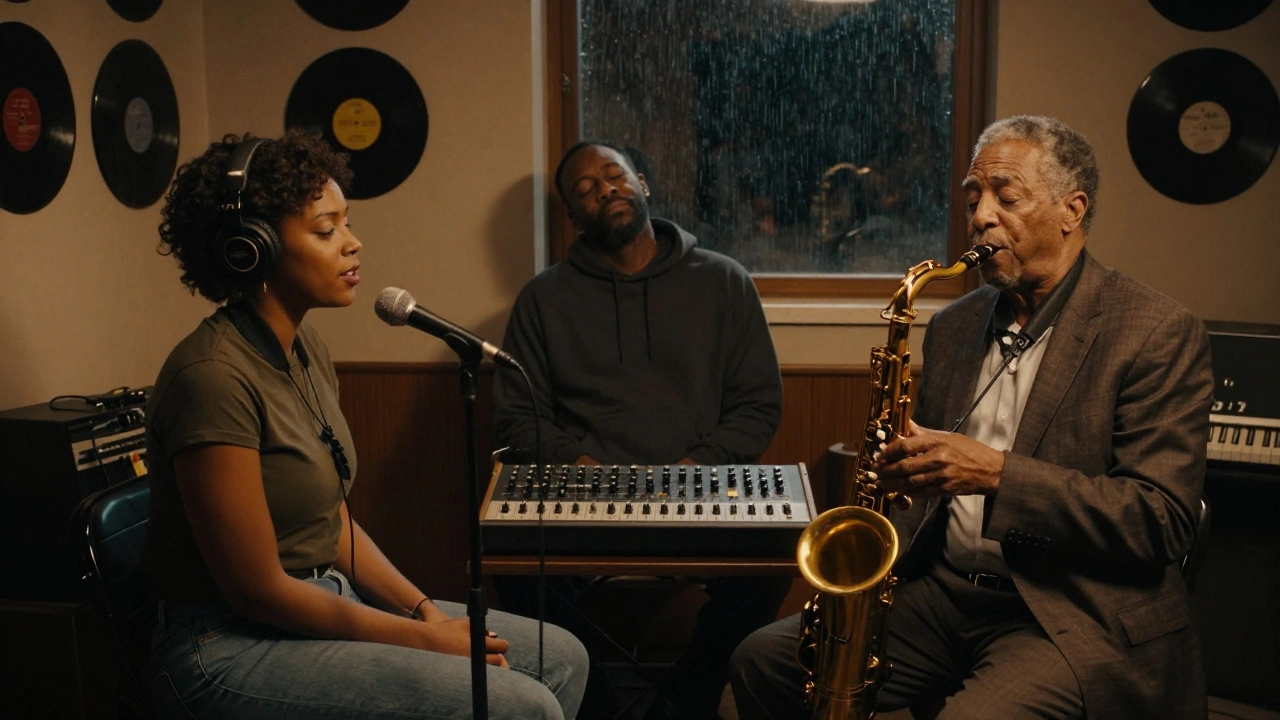
When a 28-year-old R&B singer teams up with a 72-year-old jazz legend and a 50-year-old quiet storm icon, you don’t just get a song-you get a time machine. That’s exactly what happened when Alli Starr brought together Avant and Ronnie Laws for a live studio session that blew past genre lines and generational gaps. This wasn’t a marketing stunt. It wasn’t a nostalgia tour. It was raw, real, and deeply musical.
Who Is Alli Starr?
Alli Starr didn’t grow up listening to vinyl. She grew up on Spotify playlists that shuffled between Sade, H.E.R., and old-school D’Angelo. Her voice? Smooth, but with bite. Her lyrics? Honest. She writes about love, trauma, and healing like she’s talking to her younger self. Her 2024 album Still Learning hit No. 3 on the R&B charts, but it was her live performance at the Detroit Jazz Festival that caught Avant’s attention. He messaged her after the show: "You sing like you’ve lived every note. Let’s do something."
Starr didn’t know much about Ronnie Laws before that. She knew his name from her mom’s old CDs. "I thought he was just the guy who sang ‘Forever and a Day’," she said in an interview. "Turns out, he’s the reason half the smooth R&B we hear today even exists."
Avant: The Bridge Between Eras
Avant, born in 1976, came up in the late ‘90s with that signature whisper-sing style that made him a staple on BET’s 106 & Park. His 2000 album My Thoughts sold over 800,000 copies. He didn’t chase trends. He built a sound-quiet, emotional, intimate-that still echoes in artists like Bryson Tiller and Summer Walker.
But Avant’s real strength? He never stopped evolving. In 2023, he started producing tracks with younger artists using analog synths and live bass. He told Billboard: "I don’t care if you’re 18 or 80. If you feel the music, you belong in the room."
When he brought Alli Starr and Ronnie Laws into the studio, he didn’t direct. He listened. He let the music breathe. The result? A 12-minute track called "Echoes in the Rain," layered with Laws’ flute lines, Starr’s harmonies, and Avant’s soft, aching vocals.

Ronnie Laws: The Quiet Architect of Soul
Ronnie Laws, born in 1953, is one of the most underrated saxophonists in modern soul. He played on Marvin Gaye’s Here, My Dear and backed up Stevie Wonder in the ‘70s. His 1975 album Friends is a jazz-funk masterpiece. But he never became a household name. Why? He didn’t want to. He preferred studio work, small clubs, and mentoring young musicians.
When he heard Alli Starr’s demo, he called his old engineer. "I need to hear this girl sing live. Now." He showed up to the session with his 1967 Selmer sax, no rehearsal, no script. He played one solo-38 seconds long-and walked out. "That’s it," he said. "I don’t need to play more. She already said what I was trying to say for 50 years."
That solo? It’s the heart of "Echoes in the Rain." Critics called it "the most soulful moment in R&B this decade."
How Did This Even Happen?
It started with a DM. Alli Starr sent Avant a cover she did of his 2006 song "Read Your Mind." He replied within an hour. They met for coffee. Two weeks later, he invited her to his home studio in Atlanta. She brought her producer. He brought Ronnie Laws’ number. No agent. No label. Just three people who believed music should outlive trends.
The session lasted 14 hours. They recorded six songs. Only one made the final cut-"Echoes in the Rain." The others? They’re sitting in a hard drive labeled "The Unreleased."
What made it work? Three things:
- Respect without reverence. No one treated Ronnie Laws like a relic. He was treated like a peer.
- Space for silence. They didn’t fill every second with notes. They let the air between the sounds carry emotion.
- No genre police. No one said, "That’s not soul," or "That’s not jazz." The music just was.

What Does This Mean for Music Today?
Too often, "collaborations" today are just name-dropping. A pop star teams up with a rapper. A TikTok influencer gets featured on a country track. It’s transactional. This? It was transformational.
Alli Starr didn’t need Avant to boost her profile. She didn’t need Ronnie Laws for clout. She needed them because their sound filled a hole in her own music. Avant didn’t need to prove he still matters. Ronnie Laws didn’t need to be "discovered." They needed each other because the music was calling.
This lineup-28, 50, 72-shows something rare: that great music doesn’t age. It deepens. The next generation doesn’t have to replace the past. They can carry it forward, like a torch passed hand to hand, not screen to screen.
Why This Collaboration Matters
There are thousands of artists out there who never get a chance to work with legends. And there are legends who feel forgotten. This project proves that connection doesn’t need a budget. It just needs curiosity.
Starr says she’s working on a new album with two more artists from different generations. One’s 81, a blues guitarist from Mississippi. The other’s 19, a lo-fi producer from Brooklyn. "I’m not trying to make history," she said. "I’m just trying to make music that feels true."
And that’s the quiet revolution happening right now-not in the charts, not in the ads, but in studios, basements, and late-night Zoom calls. Where age doesn’t matter. Only feeling does.
Who are Alli Starr, Avant, and Ronnie Laws?
Alli Starr is a 28-year-old R&B singer known for emotionally raw lyrics and modern soul production. Avant is a 50-year-old R&B artist famous for his 2000s quiet storm hits and smooth vocal style. Ronnie Laws is a 72-year-old jazz and soul saxophonist and flutist who played on classic albums by Marvin Gaye and Stevie Wonder in the 1970s. Together, they created the track "Echoes in the Rain," blending soul, jazz, and contemporary R&B.
What genre is "Echoes in the Rain"?
"Echoes in the Rain" is a fusion of soul, jazz, and contemporary R&B. It features Ronnie Laws’ flute and saxophone lines rooted in 1970s jazz-funk, Avant’s signature whisper-sing vocal style from 2000s quiet storm R&B, and Alli Starr’s modern harmonies and production that echo artists like H.E.R. and SZA. The track resists strict genre labels, prioritizing emotional flow over category.
Was this collaboration planned by a record label?
No. The collaboration began with a direct message from Alli Starr to Avant after a live performance. Avant invited her to his studio, and he personally reached out to Ronnie Laws, whom he had admired for years. There was no label involvement, no marketing team, and no press release. It was entirely artist-driven and self-funded.
Why is Ronnie Laws considered influential despite not being a mainstream star?
Ronnie Laws is considered influential because his playing shaped the sound of 1970s soul and jazz fusion. He contributed to landmark albums like Marvin Gaye’s Here, My Dear and Stevie Wonder’s Conversation Peace. His 1975 album Friends became a blueprint for smooth jazz and quiet storm R&B. Many modern artists cite his tone, phrasing, and use of the flute as foundational to their own style-even if they never knew his name.
Can this kind of collaboration happen today outside major labels?
Yes-and it’s happening more often. With digital tools, artists can record high-quality music from anywhere. Social media allows direct connections between creators of all ages. Alli Starr’s collaboration proves you don’t need a label to bridge generations. You just need courage, curiosity, and a willingness to listen.