Most singers stick to one lane. Jazz crooners stay in smoky lounges. Punk vocalists scream into feedback. Pop stars chase chart trends. But Alli Starr doesn’t fit any box. She can swing a 1940s standard like Ella Fitzgerald, then shift into the raw, breathy growl of PJ Harvey-without missing a beat. Her voice isn’t just versatile. It’s a living archive of vocal techniques, shaped by years of listening, failing, and relearning how to sing.
How She Started: Classical Training Meets Garage Bands
Alli grew up in Portland, Oregon, singing in church choirs and taking classical voice lessons. Her teacher insisted on perfect breath support, clear diction, and a neutral tone. But at 16, she found a dusty cassette of Siouxsie and the Banshees a post-punk band known for Siouxsie Sioux’s wild, theatrical vocal delivery. That cassette changed everything. She started singing along-not to match the tone, but to mimic the emotion. The way Siouxsie stretched syllables like taffy, the way she let cracks in her voice become part of the song-that wasn’t in her lesson books.
She began sneaking into basement gigs at local punk venues. She’d sing backup, then step up to the mic when the lead singer passed out. No one told her she couldn’t sing jazz next to a distortion pedal. She just did. Her voice got rougher. Her control got tighter. She learned that a shaky vibrato in a ballad could be a flaw-or a weapon, depending on how you used it.
The Anatomy of Genre-Specific Vocal Techniques
Alli doesn’t just sing different genres. She studies their anatomy. Here’s what she’s noticed after a decade of switching styles:
- Standards (Jazz/Big Band): Requires precise pitch control, minimal vibrato, and forward resonance. The goal is clarity, not power. Think Billie Holiday a jazz vocalist known for her intimate phrasing and subtle emotional nuance-every note feels like a whispered secret.
- Alt-Rock/Indie: Relies on vocal fry, breathiness, and dynamic shifts. Singers like Courtney Love an alternative rock singer known for her abrasive, emotionally raw vocal delivery use their voice like a guitar-distorted, broken, reassembled.
- Soul/R&B: Built on melisma, controlled growls, and chest-dominant resonance. Think Aretha Franklin a soul singer whose vocal power and improvisational style defined a generation. The voice doesn’t just carry melody-it carries muscle.
- Country: Needs twang, nasal placement, and conversational phrasing. Not about hitting high notes-it’s about sounding like you’re talking to a friend on a porch at midnight.
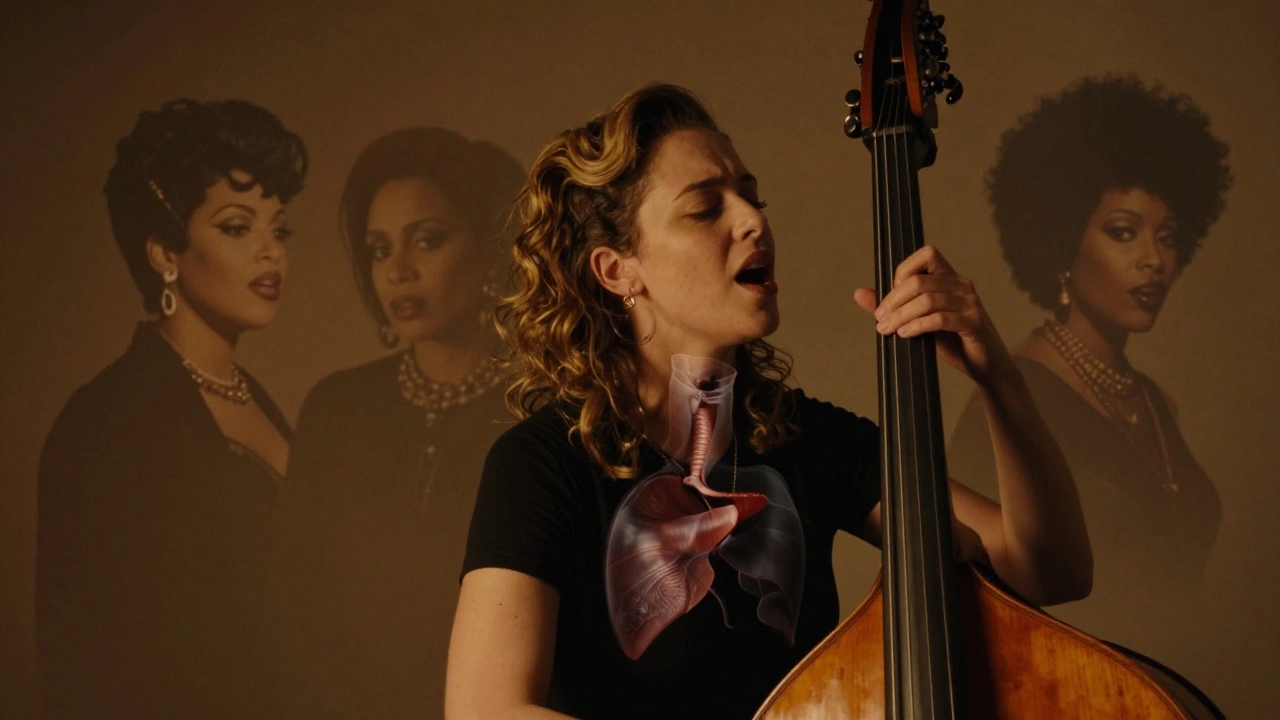
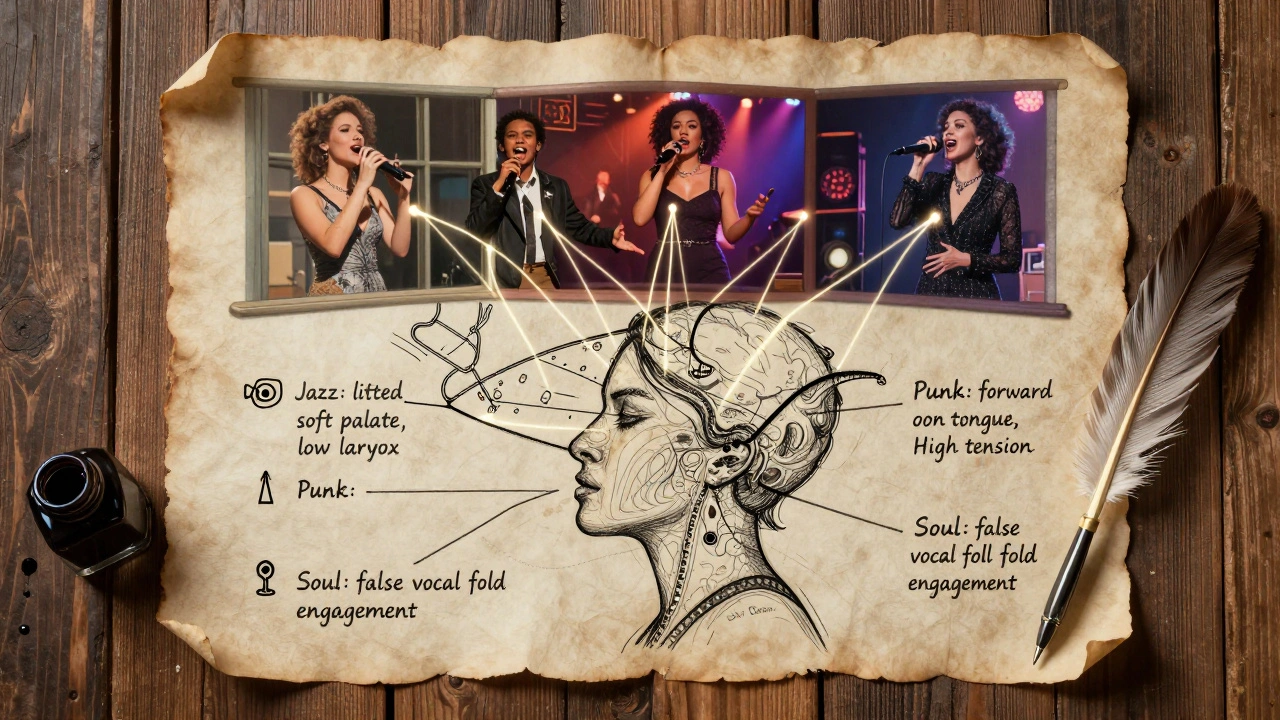
Alli’s secret? She doesn’t try to sound like them. She learns how their vocal cords move. She records herself imitating each style, then analyzes the waveform. She’s found that a country twang uses a different tongue position than a jazz scat. A soul growl engages the false vocal folds. A punk scream isn’t about volume-it’s about releasing air without letting the larynx clamp down.

Training Like an Athlete, Not an Artist
Most vocal coaches teach technique as if it’s art. Alli treats it like training for a triathlon. She has a daily routine:
- 10 minutes of humming to warm the soft palate
- 15 minutes of sirens to stretch vocal range
- 20 minutes of genre-specific drills: scatting in jazz mode, whisper-singing in indie mode, growling in soul mode
- 10 minutes of listening-just listening-to one artist from a genre she’s not comfortable with
She doesn’t sing songs until she can replicate the vocal texture. If she’s learning a Nina Simone a jazz and soul singer known for her intense emotional expression and piano-driven performances ballad, she’ll spend three days just matching the way Nina lets her voice dip below pitch on the word "love." Not to sound like her. To understand how the tension in the throat creates that ache.
She keeps a notebook. Not lyrics. Not chords. Vocal maps. She sketches how her larynx feels when she sings in different styles. She labels them: "Jazz: lifted soft palate, low larynx," "Punk: forward tongue, high tension." She’s built her own vocal anatomy chart.
Why Most Singers Fail at Genre Switching
It’s not about range. It’s about identity. Most singers resist switching genres because they’re afraid of losing their "sound." They think their voice is a fixed thing-like a signature. But Alli’s voice isn’t fixed. It’s a toolkit.
She’s seen singers try to force a country twang into a punk song. It sounds fake. She’s heard jazz singers over-enunciate in a soul track, killing the groove. The problem isn’t technique. It’s ego. You can’t sing like Aretha Franklin if you’re too busy trying to sound like yourself.
Alli’s breakthrough came when she stopped asking: "Can I sing this?" and started asking: "What does this song need from my voice?"
Her Most Unexpected Cover: A Metal Song in Jazz Style
Two years ago, she recorded a cover of Metallica’s a heavy metal band known for aggressive guitar riffs and intense vocal delivery "Master of Puppets"-but as a slow, smoky jazz ballad. No drums. Just upright bass, brushed snare, and her voice, floating over the chords like smoke.
It went viral in niche circles. Jazz purists called it "sacrilege." Metal fans called it "haunting." But the real reaction? From vocal coaches. They started emailing her. "How did you make those growls sound like vibrato?" "How did you keep the tension without screaming?"
She didn’t change the melody. She changed the muscle. She used jazz breath support to control the power. She used soul vocal fry to mimic the distortion. She didn’t sing like Metallica. She sang like a jazz singer trying to replicate what Metallica’s voice sounded like inside.
What Cross-Genre Literacy Really Means
It’s not about being a chameleon. It’s about understanding how the human voice works under pressure. How emotion shapes vibration. How culture shapes breath.
Alli’s voice now carries the weight of 50 years of American music. She doesn’t need to pick a genre. She lets the song pick her.
That’s the real lesson: Your voice isn’t yours to protect. It’s yours to borrow. And every genre you learn, you give back something new to the next singer who dares to try.
Can anyone learn to sing across genres, or is it a natural talent?
Anyone can learn to sing across genres-but it takes more than practice. It takes curiosity. You need to listen like a scientist, not a fan. Most people think vocal range is the key, but it’s about muscle memory. If you can mimic the physical sensations of different styles-how the throat tightens in punk, how the diaphragm drops in jazz-you can train your voice to switch. Alli Starr didn’t start with a wide range. She started by recording herself imitating three different singers every day for six months.
What’s the biggest mistake singers make when switching genres?
Trying to sound like the original artist instead of understanding what the genre demands. A lot of singers think country means adding twang, or soul means adding runs. But it’s deeper. Country is about honesty in phrasing. Soul is about physicality in tone. If you just copy the surface, it sounds like karaoke. The real skill is decoding the body language of the voice-how the jaw moves, where the breath lands, how the vocal cords engage.
Do you need formal training to sing across genres?
Not necessarily. Alli Starr had classical training, but she learned more from listening to punk shows than from her voice teacher. Formal training gives you control. But genre-switching requires breaking rules. The best singers in cross-genre spaces often start with structure, then unlearn it. Think of it like learning to drive stick shift, then learning to drive on ice. You need the basics, but the real skill is knowing when to let go.
How long does it take to become fluent in multiple vocal styles?
It’s not about time-it’s about depth. Alli spent three years just on jazz and alt-rock before adding soul. She didn’t move on until she could sing a jazz standard and an indie rock ballad back-to-back without resetting her throat. Most people try to learn five styles in six months and burn out. True fluency takes 2-5 years of daily, focused practice. One hour a day, consistently, beats five hours once a week.
Is cross-genre singing useful for professional singers?
Absolutely. Studio singers who can switch styles get hired more often. A pop producer might need someone who can sing like Adele one day and like Billie Eilish the next. Live performers who can adapt to different bands get more gigs. It’s not about being a jack-of-all-trades-it’s about being the only person who can do what the song needs, right now. In today’s music industry, versatility isn’t a bonus. It’s the baseline.